
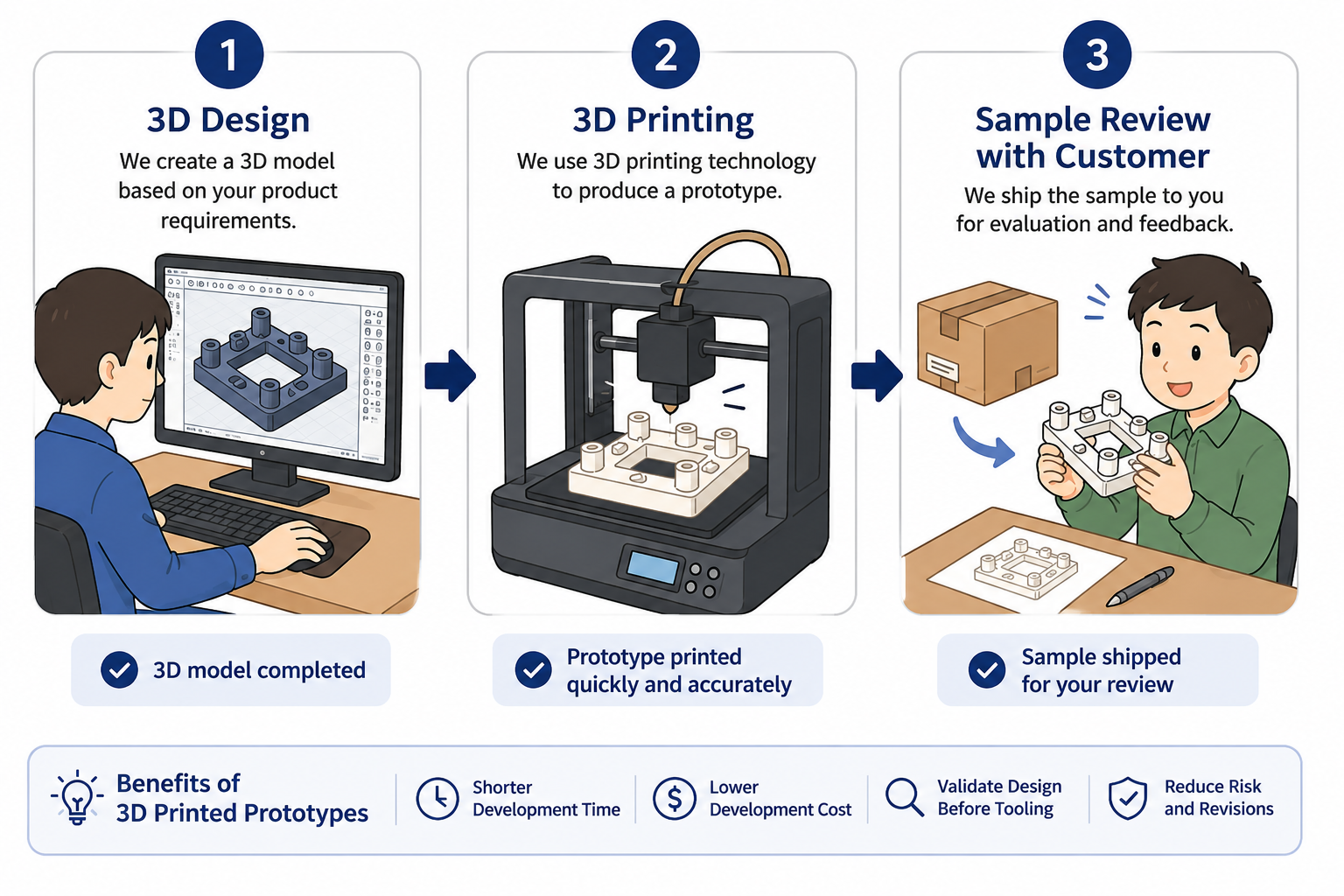
Once a product design is completed, many people assume that the next step is to proceed directly to mold development and production. However, creating a 3D printed prototype before investing in tooling can significantly reduce development risks and help avoid costly modifications later in the process.
For many custom products, engineering drawings and CAD models can accurately present dimensions and structural details. However, actual assembly, functionality, and user experience often need to be verified through a physical prototype. As a result, 3D printing has become an essential part of modern product development.
What Is a 3D Printed Prototype?
A 3D printed prototype is a physical model produced directly from a CAD design. It allows designers, engineers, and customers to evaluate the product’s appearance, dimensions, assembly method, and structural design before moving into production.

Compared with mold manufacturing, 3D printing offers faster turnaround times, greater design flexibility, and lower development costs, making it an effective tool for identifying potential issues early in the development process.
Why Is Prototype Validation Important Before Tooling?
Even when a design appears correct on screen, unexpected issues may arise once the product becomes a physical object. Common examples include:

Insufficient assembly clearance
Interference between components
Unsatisfactory proportions or appearance
Poor ergonomics or user interaction
Structural weaknesses

If these issues are discovered after mold fabrication, additional tooling modifications—or even a complete mold redesign—may be required. This can lead to increased costs, production delays, and extended time-to-market.

By validating the design with a 3D printed prototype, potential problems can be identified and resolved much earlier, reducing overall development risks.
From DFM Analysis to Prototype Validation
In product development, Design for Manufacturability (DFM) analysis and 3D prototype validation often work hand in hand.

DFM helps determine whether a product is suitable for efficient manufacturing and mass production, while 3D printing transforms design concepts into physical samples for practical evaluation.

Together, these processes improve development efficiency, increase the likelihood of project success, and provide a stronger foundation for tooling and production.
Greater Confidence Before Mold Development
Tooling is often one of the most significant investments in the product development cycle.

By validating a design through 3D printed prototypes before mold fabrication begins, companies can confirm design intent, reduce modification risks, shorten development timelines, and improve the overall efficiency of production preparation.

At Shun Yi Co., Ltd., we believe that successful products are built on thorough planning, careful evaluation, and effective validation. Through comprehensive pre-production assessment and prototype verification, we help our customers move from concept to production with greater confidence and efficiency.
June 23, 2026 | Shun Yi Co., Ltd.