

A wheelchair foot pedals may appear to be a simple accessory, but it directly affects lower-limb support, seating posture, and everyday convenience for the user.
In real-world use, a foot pedals must accommodate the user’s lower-limb support needs, withstand everyday impacts, and integrate properly with the wheelchair frame and its mounting mechanism. From dimensions and structural design to the mounting method, every detail needs to respond to actual use conditions.
Different Structures for Different User Needs
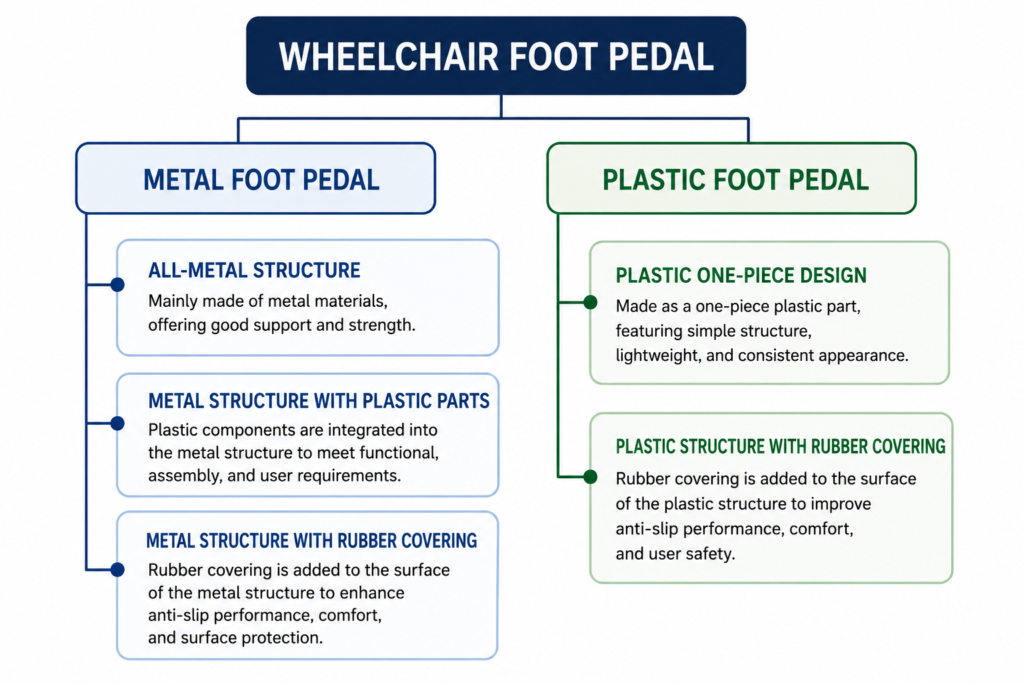
Wheelchair foot pedals do not come in a single form. Based on their primary structural material, they can generally be divided into metal foot pedals and plastic foot pedals. Depending on product positioning, assembly methods, and intended use, each category can be developed into different structural configurations.

Metal foot pedals may use an all-metal construction or incorporate plastic components and rubber overmolding. These designs typically focus on the supporting structure, mounting method, and compatibility with the wheelchair frame, while surface contact, assembly convenience, and other functional details are adjusted according to actual requirements.

Plastic foot pedals may be produced as one-piece molded parts or combined with rubber overmolding on the surface. Compared with metal structures, plastic components offer different design flexibility in form integration, weight control, and surface design. However, development must also account for material properties, structural layout, load distribution, and production consistency.

As a result, even for the same wheelchair foot pedal, material and structural choices directly influence the assembly method, user experience, and downstream manufacturing requirements.
Design Considerations Behind Different Foot Pedal Configurations
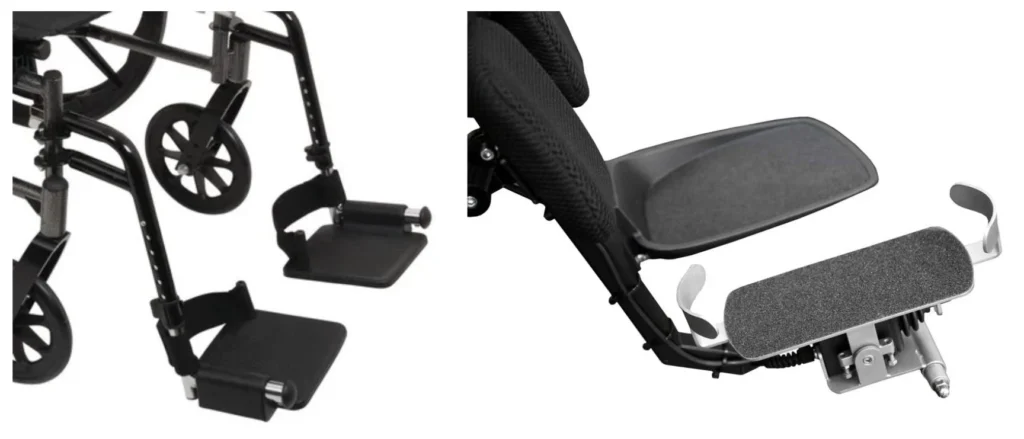
Right image reference: Permobil® wheelchair footrest design, used for structural and application reference only.
Using Shun Yi’s own-brand one-piece plastic wheelchair foot pedal as an example, the design is not focused on appearance alone. It is developed through an integrated consideration of the user contact surface, structural configuration, and folding and storage conditions.

Because this type of foot pedal is manufactured as a one-piece plastic molded part, we incorporated a raised anti-slip texture across the stepping surface. When viewed up close, the pattern resembles the arrangement of diamond-cut facets, which is why it is also referred to as a “diamond-pattern foot pedal.” In addition to creating a more distinctive appearance, this surface design improves contact between the user’s foot and the pedal.

We also designed an anti-slip positioning feature at the connection point between the foot pedal and the tubing. When the foot pedal is folded upward for storage, this feature helps maintain appropriate engagement between the pedal and the tube, reducing the likelihood of the pedal slipping down due to looseness. This provides greater stability during everyday use and storage.

By comparison, some foot pedals used on powered wheelchairs adopt a metal structure combined with plastic components. These products are typically not just a single stepping surface; they form part of a module that includes brackets, folding mechanisms, mounting points, and other front-end components.

In this type of configuration, metal components are primarily responsible for support and connection, while plastic components can be used for the stepping surface, outer covers, protective areas, or localized assembly points. This allows the product to balance structural requirements, exterior integrity, and user-contact surfaces. Because powered-wheelchair foot pedal modules may be subject to repeated folding, adjustment, impact, disassembly, and maintenance, their design must also consider the fastening method between components, assembly tolerances, and the convenience of future replacement.
Whether using a one-piece plastic design or a modular design that combines metal structures with plastic components, the key is not the material alone, but whether the design can meet the product’s intended use, assembly requirements, and long-term maintenance needs.
June 25, 2026 | Shun Yi Co., Ltd.